How corporate venture capital de-risks emerging technology development

As the pace of technological change accelerates, corporations are no longer just adapting to disruption — they are actively investing in it. Through their corporate venture capital (CVC) arms, established companies are entering partner-investor relationships with startups across frontier domains such as artificial general intelligence (AGI), humanoid robotics, quantum computing, and other potentially game-changing technologies.

In this post, I’m exploring how corporates are using CVC to de-risk exploration in these emerging tech domains, the competitive advantage of corporate-startup partnerships, which categories are particularly well suited to CVC versus traditional VC, and how emerging-tech startups can best position themselves for CVC investment.

How CVC reduces technology risk for corporations

Corporations face an inherent tension: they need to pursue innovation and new business models, but they also must manage risk, protect core business margins, and maintain operational stability.

That’s why more than 25% of the funding deals last year included CVCs. CVC offers a hybrid path: by investing in and partnering with startups in nascent and emerging technologies, corporates can explore adjacent or disruptive opportunities while externalizing much of the technology risk.

In domains such as AGI, quantum computing, space tech, or next-gen energy storage, the technologies are capital-intensive, have long horizons, involve high technical and commercialization risk, and often require domain-specific assets, manufacturing, regulatory engagement, or ecosystem partnerships. For corporations, investing via CVC is a strategic way to gain early exposure, build optionality, secure technology rights or vantage, and integrate promising startups into their ecosystem — enabling them to stay ahead of both disruptive threats and complementary opportunities.

However, not all companies should invest in all emerging technologies — the key is strategic selectivity, focusing on technologies that could either disrupt their industry or offer complementary capabilities to enhance their competitive position.

CVC is a de-risking engine for corporates exploring emerging tech — it lets them access options in high-uncertainty spaces without the full burden of building in-house, while building strategic alignment with their core business and future growth vectors.

How CVCs reduce technology risk through strategic value creation

While most emerging tech startups will need venture capital funding, nearly all funding deals can benefit significantly from CVC participation. The question isn’t whether corporate venture capital adds value, but rather how CVCs uniquely reduce technology risk for both corporates and startups across different technology categories.

What makes CVC different from traditional VC?

CVC brings strategic value beyond capital: manufacturing capabilities, distribution networks, supply chain access, regulatory expertise, and direct integration pathways. Traditional VC focuses primarily on financial returns and rapid scaling without operational entanglement.

Especially suited for CVC

Best for: Hardware, long horizons, strategic fit, high-capex technologies

  • Hardware + embedded systems (e.g., humanoid robots, advanced compute, quantum computing, next-gen energy storage, nuclear energy) — These domains require supply chain, manufacturing, and integration with existing platforms, often with regulatory or domain-specific partnerships. Corporations with manufacturing or platform assets can add real value. For example, HP Tech Ventures’ investment in EdgeRunner AI demonstrates how corporates can accelerate AI hardware integration. EdgeRunner builds domain-specific, air-gapped, on-device AI agents for military and enterprise applications that operate entirely without internet connectivity. The company’s platform delivers mission-specific AI assistants that ensure low latency, enhanced data privacy, and reduced cloud costs — critical advantages that scale when coupled with AI hardware platforms and edge computing products and expertise. Similarly, Intel Capital’s investment in Rigetti Computing showcases how corporate backing accelerates quantum computing development. Rigetti builds full-stack quantum computers, and Intel’s expertise in chip manufacturing, supply chain access, and deep semiconductor knowledge provides strategic advantages that pure financial investors cannot match, reducing both technical and commercialization risk.
  • Platform or ecosystem technologies (technologies that require broad industry adoption and create value through network effects, such as 6G/hyperconnectivity, clean-tech infrastructure etc.) — Corporates are often deploying or will deploy these platforms themselves, so investing via CVC gives them inside access and optionality.
  • Strategic technology adjacencies for the corporate. For example, if a corporate sees synthetic biology or biotech as a future adjacency to their business, then CVC allows them to explore while leveraging internal capabilities (e.g., R&D, supply chain, global operations).
  • High-capex / long-horizon technologies — Traditional VCs demand high returns within a fixed timeline, but corporates can afford longer horizons if strategic alignment is strong.

Related to the above, trending data show that CVCs have recently been prioritizing AI and Robotics, which exemplify both platform technologies and strategic adjacencies that many corporates are exploring. For example, nearly 30% of CVC deals in 2024 revolved around AI.

HP Tech Ventures’ recent investment in Multiverse Computing — a quantum-inspired AI company that compresses large language models by up to 95% while maintaining performance — exemplifies this trend. Multiverse’s technology addresses a critical infrastructure challenge in AI deployment, enabling models to run on edge devices and dramatically reducing computing costs and energy consumption.

HP’s strategic support helps Multiverse scale this technology across enterprise applications, bringing AI benefits to companies of all sizes.

Making it work for both CVC and startup

In the accelerating wave of frontier technologies — from AGI and quantum computing to next-gen energy storage, synthetic biology, and space tech — the smart corporates will not wait passively. They will deploy their CVC as a strategic lever to access, partner with, and accelerate startups that can redefine their future business models.

How do startups benefit from CVC partnerships?

For startups operating in these domains, the path to growth means not just securing capital, but forging the right strategic partnerships: ones that bring scale, integration, and access to a corporate ecosystem that would otherwise take years to build.

For HP Tech Ventures, this means offering portfolio companies access to HP’s world-class technology, one of the world’s largest channel and distribution partner networks, and a vast global manufacturing and supply chain — resources that help startups scale rapidly and achieve significant market impact.

Emerging tech sectors alignment

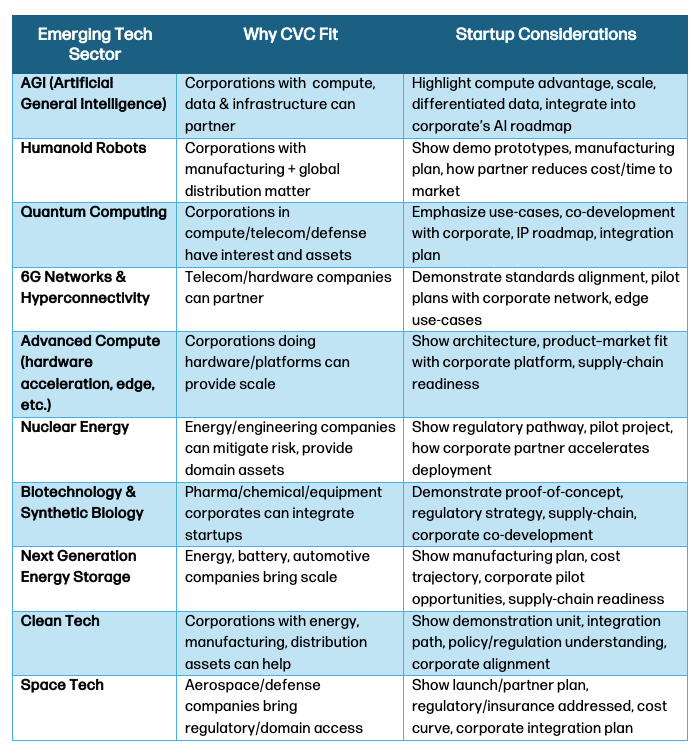
From humanoid robots to synthetic biology, the next wave of innovation is rewriting the boundaries of what’s possible — and CVCs are uniquely positioned to shape that future. The following table maps how each major emerging-tech sector aligns with corporate venture capital, and what founders should keep in mind as they navigate this evolving landscape.
What should founders consider when pursuing CVC?

By aligning technology, business model, partner strategy, and timing, both corporations and startups can ride the emerging-tech wave with lower risk and higher impact.

If you’re a startup in one of these frontier domains and are thinking about CVC, ask yourself: Which corporations in my value chain have scale, distribution, or manufacturing that could accelerate me? How much risk are they willing to take? Am I ready for strategic integration?


Blog corporate venture capital
business meeting with man with blue tie speaking

Why startups are leaning into Corporate Venture Capital in 2025 [+ 8 TIPS FOR FOUNDERS]

What founders need to know:

  • CVCs are participating in one of every six startup funding rounds
  • They are backing startups of all sizes, with 65% of their deals now happening at early stages
  • Beyond capital, these relationships offer invaluable resources: distribution channels, technical expertise, and supply chain leverage that traditional VCs rarely provide

In the ever-evolving venture capital landscape of 2025, one trend has become impossible to ignore: startups are increasingly turning to Corporate Venture Capital (CVC) for funding, strategic partnerships, and competitive advantages. This shift isn’t just about money—it represents a fundamental change in how emerging companies view their path to success.

The surge of corporate investors in the VC ecosystem

The numbers tell a compelling story. The number of corporate investors has tripled in the last decade, and they now participate in one of every six startup funding rounds. This isn’t a temporary blip—it’s a sustained transformation of the venture capital landscape.

CVCs’ share of the venture pie continues to expand:

  • 28% of all venture deals in 2024 included at least one corporate investor—a level that has remained in the high 20s for nine consecutive years.
  • 35% of global deal value in Q4 2024 came from CVC-participating rounds, marking the highest quarterly share since 2019, as reported by Bain.
  • Corporate investors gravitate toward larger tickets, which means their share of dollars is trending higher than their share of deals, indicating growing influence over the biggest checks in the industry.

CVCs are dominating mega-rounds

When it comes to the crucial nine-figure funding rounds that can make or break scaling companies, corporate investors have become indispensable:

  • In 2024, over half of all CVC dollars went into rounds of $100 million or more. AI innovators like Perplexity and Lightmatter topped the league tables for the largest CVC-backed deals.
  • The median US deal size with CVC participation was three times larger than non-CVC deals in 2024.
  • Large corporations can fund capital-intensive bets in emerging fields like AI infrastructure, semiconductors, and climate tech, where many traditional VCs hesitate to commit significant capital independently.

Moving earlier in the funding funnel

Perhaps most surprisingly, corporate investors aren’t just waiting for startups to prove themselves before getting involved. Early-stage rounds comprised 65% of CVC deals in 2024, tying the highest share in a decade.

This early engagement signals a fundamental shift, with startups increasingly viewing corporates not merely as strategic late-stage partners but as first-check believers in their vision.

The survival advantage: CVC-backed startups fail less often

According to GCV’s 2024 “The World Of Corporate Venturing” report, the numbers tell a startling story: startups without CVC funding were more than twice as likely to go bankrupt compared to their CVC-backed counterparts. The advantages don’t stop at survival. CVC-backed companies are also twice as likely to advance to the next funding round, creating a compounding advantage throughout their growth journey.

This isn’t just correlation—there are concrete reasons why CVC backing provides a survival advantage.

Strategic advantages CVCs offer beyond capital

In-the-trenches advisors and mentors

CVC partners often provide specialized industry expertise that traditional VCs may lack, including seasoned advisors who have experience and have navigated similar challenges in the corporate world.

Credibility and market validation

A corporate investment serves as a powerful signal to the market, customers, and other potential investors that established industry players have vetted your solution.

Access to distribution networks

The right corporate partner can dramatically accelerate a startup’s go-to-market strategy:

  • Amazon’s backing of Rivian provided capital and a massive initial order for electric delivery vehicles.
  • HP uses its global scale and reach to help support the scaleup of our portfolio companies, whether that be connecting them with new customers to putting a marketing spotlight on their achievements.
  • Walmart’s partnership with vertical farming startup Plenty secured investment and nationwide distribution for its sustainably grown produce.

Supply chain leverage

Corporate backing can transform a startup’s position in the supply chain:

  • Tyson Foods’ investment in Beyond Meat gave the plant-based protein startup unprecedented access to meat distribution channels historically closed to alternative protein companies.

R&D synergy and advancement

The R&D resources of corporate partners can accelerate innovation:

  • Moderna gained access to AstraZeneca’s extensive R&D capabilities and clinical trial networks, accelerating its path to market.
  • OpenAI’s partnership with Microsoft provided crucial access to Azure cloud computing resources, enabling the development of increasingly sophisticated AI models.
  • SoundHound integrated its AI-powered Houndify platform directly into Honda vehicles, gaining access to real-world testing environments that would have been impossible to access otherwise.

Channel access

Strategic CVC partnerships can unlock entire market channels:

  • ChargePoint’s investments from Siemens and Daimler opened doors to integrated EV charging solutions across the automotive and energy sectors.

Customer base access and brand credibility

A corporate partner’s customer relationships can be invaluable:

  • Google’s early investment in Uber helped the ridesharing company establish credibility and integration with Google Maps.
  • Salesforce’s backing of Snowflake provided enterprise validation that accelerated the data cloud company’s adoption among large organizations.

Tips for successful startup-CVC collaboration

For founders considering CVC partnerships in 2025, these strategic approaches can maximize success:

1.          Understand synergy and conflict points

Map out where your interests align with potential corporate investors—and where they might diverge. Be explicit about these in early discussions to avoid painful misalignments later.

2.        Define what success looks like

Is your primary goal additional funding, a proof-of-concept partnership, co-marketing opportunities, or something else? Clarifying expectations early helps both parties measure progress.

3.        Consider scale compatibility

Ensure your startup can reasonably meet the scale requirements of your corporate partner, especially if product integration is a goal.

4.        Qualify interest rigorously

Don’t let big companies waste your most precious resource—time. Look for concrete commitments rather than vague expressions of interest.

5.        Charge for proofs-of-concept and pilots

Getting paid for initial work serves as an excellent qualifier of serious interest. Free pilots often indicate low organizational commitment.

6.        Establish internal champions

Identify and cultivate relationships with specific executives who will advocate for your startup within the corporate structure. These champions are critical for helping you navigate complex organizational dynamics.

7.         Prepare for extended sales cycles

Corporate decision-making, approvals, contracts, and procurement processes typically move much slower than startup timelines. Build this reality into your planning and runway calculations.

8.       Research strategic priorities

Study your potential corporate investor’s latest earnings calls and investor relations materials. As one venture advisor noted, “Listen to the latest corporate investor relations call for insights into what’s on the CEO’s mind, and as context for potential synergies and partnership opportunities.”

Next steps

As we navigate 2025’s challenging funding environment, CVCs represent not just a capital source but potentially transformative partnerships that provide startups with strategic advantages beyond what traditional VCs typically offer.

The data is clear: corporate venture capital has evolved from an occasional player to a central force in the startup ecosystem, offering both enhanced survival rates and accelerated paths to market leadership.

For today’s founders, the question is increasingly not whether to consider corporate venture capital, but how to strategically leverage these partnerships to maximize short-term growth and long-term success.

Entrepreneurship Uncategorized

Driving Strategic Value through Corporate Venture Capital

Since 2014, corporate venture capital (CVC) has participated in over 21% of venture capital deals with 46% of total VC deal value. Yet, according to PitchBook the number of CVC-backed companies their CVC investors eventually acquired has remained below 4%.

If mergers and acquisitions (M&A) aren’t the primary drivers of the active CVC landscape, what motivates companies worldwide to invest in startups?

Investing for strategic advantage

As the world of technology has continued to flourish and startup companies have emerged as drivers of innovation and markets, larger corporations have looked for ways to tap into the startup and venture communities to drive new business growth and stay competitive. Corporate venture capital allows companies to look beyond their core business to explore and drive future growth opportunities.

Unlike traditional venture capital firms, in many cases CVCs invest strategically to align with their parent company’s long-term goals. These investments drive market and technology insights and help foster strategic partnerships that provide startups with access to enterprise resources—such as distribution channels, marketing, and manufacturing—while allowing corporations to stay ahead of industry trends and technological advancements.

Value creation

As HP’s corporate venture arm, HP Tech Ventures focuses on three key areas of value creation:

  1. Strategic Investments—HP Tech Ventures invests in startups aligned with our corporate strategy to drive insights, deepen commercial relationships, strengthen HP’s market position, and hedge against future industry shifts. These investments aim to drive growth while also delivering financial returns.
  2. Startup Partnerships—Supporting commercial partnerships with startups complements HP’s R&D efforts, helping to fill technology gaps and enhance product differentiation.
  3. Startup and Venture Insights—Investing in startups provides HP valuable insights into emerging markets and disruptive technologies. By leveraging these insights, HP can refine its strategy and remain at the forefront of industry innovation.

Example: creating value in Healthcare

HP’s investment and partnership with Adaptiiv led to the development of 3D-printed, personalized accessories for cancer radiation treatments, enabling more precise and consistent radiation dosage.

Example: creating value in Retail

HP’s investment and partnership with AiFi is enabling game-changing retail experiences. AiFi’s autonomous checkout solution is powered by AI computer vision and demonstrates what happens when technology and retail converge to really deliver on what the customer wants: convenience, speed, ease, and a more informed, personalized shopping experience. AiFi’s solution leverages the HP Engage Express and HP Z Workstations to power its next generation retail experience.

Tapping into trends

Strategic investing also offers corporations a way to tap into trends and innovations early. Investing in startups developing new technologies and business models in emerging areas allow companies to stay ahead of customer demand and position themselves for competitive success.  A great example of this is the staggering number of AI Funds created over the past few years by corporations.  From Google’s launch of Gradient back in 2017 to Cisco’s $1B AI fund established in 2024 there is ongoing, deep corporate investing in this emerging area.  In 2024, AI alone accounted for 37% of CVC-backed funding and 21% of CVC deals.

Shaping your future through investment

Long-term growth and adaptability in a rapidly changing world require companies to develop diverse strategic capabilities. Engaging with the startup ecosystem has become a crucial component of corporate success. HP Tech Ventures is dedicated to this mission, using startup investing as a strategic tool to drive innovation and enable future growth.

Blog Innovation