The art of being a futurist is a necessary skill in today’s world. Thinking like a futurist shouldn’t be reserved for a select group of people, rather a basic skill set that anyone can learn. I believe in democratizing the skills of a futurist. The more people that can see down the path, the better off we’ll be. The ongoing problems the world is facing, like poverty and climate change, cannot be solved with short-term thinking. If we want to move forward and create the future we want, we must adopt long-term, futuristic thinking.
At HP, the CTO Office team and I work to define new market segments, products, and business models that will help shape HP’s future growth. We focus on industry-shifting trends like Internet of Things, 3D transformation, immersive experiences, AI, advanced robotics, and hypermobility, to determine HP’s long-term innovation and technology vision. See below for a few things I’ve learned along the way for learning how to read signals, see trends, test your assumptions, and become a futurist:
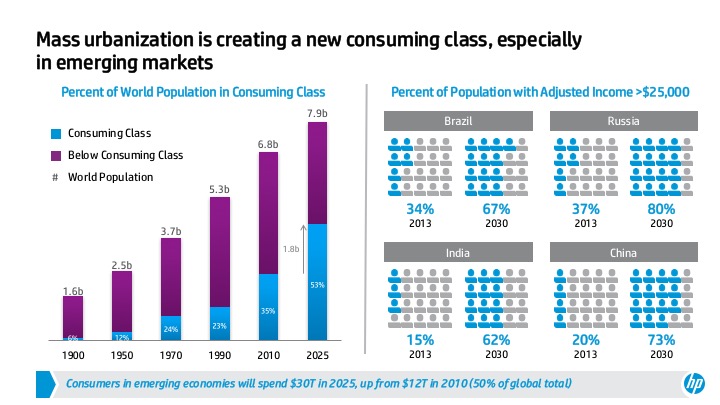
Stay up to date on trends. Socio-economic, demographic, and technological forces are impacting our future. At HP, we call these Megatrends. Megatrends allow us to directionally predict where the world is heading, and identify opportunities for HP and our customers.
Fueled by accelerating technology advancements, our rapidly changing world finds us more connected and reliant on digital technologies, altering how we live, work, and socialize with one another. It’s important to monitor both global, and technology trends to stay ahead of all this change, to innovate, adapt, reinvent and engineer experiences for a future that promises to look very different from today.
Personally, I stay on top of trends by reading the latest technology news, speaking with customers and industry pundits, paying attention to university and academic research areas, monitoring venture investing trends and start-up activity. I also draw from my personal experiences, media coverage, and public data sources.
Don’t forget, it’s important to keep an open mind when researching trends. Open yourself to considering all kinds of possible scenarios and interpretations.
Visualize. Once you identify emerging trends, the next step is powering up your imagination. Allow yourself to time-travel (at least in your mind for now) to a future date. Keeping in mind your research, imagine what the world might look like, what a daily routine would be in different parts of the world, what experiences our future-selves might encounter.
Now work back and think about how we arrived there. Ask questions about timing, what trends spearheaded those experiences, market conditions, business models and technologies. Now think about how your company, your team and you personally played a role in arriving at this future state.
For example, if you consider self-driving cars, it’s obvious that the technology will affect our future, but in what capacity? Think about these core questions: How will current markets and industries be impacted? What new opportunities will arise? What role will you or your company play in that future?
Looking at short and long-term time intervals, identify what technology advancements, business models and new solutions have the potential for the greatest impact.
As more people work to become futurists, it’s important to concentrate on the trends in a systematic, diligent way.
Put it through the business sniff test. Good business acumen is an important asset in the futurist’s tool kit. Having a strategy and methodology for testing your scenarios and hypotheses are critical.
At HP, we start with a pivotal choice point of deciding whether a new technology should be merely observed, is an incremental innovation—new feature or function, value-add to an existing product, or possible accessory—or a disruptive innovation, such as a new product or service.
Each idea then goes through a rigorous business lens to understand strategic intent—opportunity, purpose, value—business rationale and actionable outcomes.
Have boring conversations, too. It’s easy to fantasize how technology will improve our lives in the future, but it’s just as important to have tactile conversations as well. . While it’s not necessary to have a formal method for making predictions about the future, you should have a strategy. As more people work to become futurists, it’s important to concentrate on the trends in a systematic, diligent way. . Here are a few questions to spark your next “boring” conversation:
- What is your current strategy to predict the future?
- How well is that plan being executed?
- Where are place you can improve your results?
- What resources do you have available to try something different?

Adopt a growth mindset. If you have a fixed mindset, your qualities are carved in stone. If you lack a skill, you will continue to lack it. However, when you adopt a growth mindset, you can grow and change through persistence and experience. With a fixed mindset, you can be easily overwhelmed with the future’s uncertainty, but the future belongs to those who can adopt a growth mindset.
At HP, we believe a growth mindset and open innovation are a perfect match. Open innovation allows you to bring the outside in, and the inside out. The “outside in” aspect occurs when external ideas and innovation are brought into the company. On the other hand, “inside out” refers to ideas and technologies within your company that can be incorporated into others’ innovation processes.
We’re living open innovation with HP Tech Ventures. Powering the next generation of technology innovation, we’re partnering with the start-up community to share innovation “outside in” and “inside out”. Our teams focus on global, early stage investments in industry shifting trends—Hypermobility, Internet of All Things, 3D transformation, immersive experiences, advanced robotics, and artificial intelligence.
It’s for that exact community that we designed our first immersive computing platform: Sprout. It started in HP Labs, where we tried to imagine a better experience for makers. Sprout integrates five devices into one: a projector, keyboard, scanner, touch canvas, and a 3D camera.
Learn from failure. Don’t confuse failure with bad work. If your team is doing good work, innovating, and still failing, they’re still learning. It’s essential that leaders and organizations encourage and embrace failure. At HP, we say, “If you must fail, fail fast, and allow your employees to do the same.” When everyone knows they can fail, they can truly innovate.
In today’s world, we tend to feel like we don’t have control over the future, but that isn’t the case. With strategic, long-term thinking, action, and an open mind, we can improve lives, and create new businesses, markets, industries and experiences.
I’ll leave you with with one of my favorite quotes. “See first, think later, then test. But always see first. Otherwise, you will only see what you were expecting.” -Douglas Adams
A good futurist is always learning, and I’d love to hear your tips and thoughts about becoming a futurist in the comments section below.











 Andrew Bolwell