5 Tips to Think Like a Futurist

The art of being a futurist is a necessary skill in today’s world. Thinking like a futurist shouldn’t be reserved for a select group of people, rather a basic skill set that anyone can learn. I believe in democratizing the skills of a futurist. The more people that can see down the path, the better off we’ll be. The ongoing problems the world is facing, like poverty and climate change, cannot be solved with short-term thinking. If we want to move forward and create the future we want, we must adopt long-term, futuristic thinking.

At HP, the CTO Office team and I work to define new market segments, products, and business models that will help shape HP’s future growth. We focus on industry-shifting trends like Internet of Things, 3D transformation, immersive experiences, AI, advanced robotics, and hypermobility, to determine HP’s long-term innovation and technology vision.  See below for a few things I’ve learned along the way for learning how to read signals, see trends, test your assumptions, and become a futurist:

Stay up to date on trends. Socio-economic, demographic, and technological forces are impacting our future. At HP, we call these Megatrends.  Megatrends allow us to directionally predict where the world is heading, and identify opportunities for HP and our customers.

Fueled by accelerating technology advancements, our rapidly changing world finds us more connected and reliant on digital technologies, altering how we live, work, and socialize with one another. It’s important to monitor both global, and technology trends to stay ahead of all this change, to innovate, adapt, reinvent and engineer experiences for a future that promises to look very different from today.

Personally, I stay on top of trends by reading the latest technology news, speaking with customers and industry pundits, paying attention to university and academic research areas, monitoring venture investing trends and start-up activity. I also draw from my personal experiences, media coverage, and public data sources.

Don’t forget, it’s important to keep an open mind when researching trends. Open yourself to considering all kinds of possible scenarios and interpretations.

Visualize. Once you identify emerging trends, the next step is powering up your imagination.  Allow yourself to time-travel (at least in your mind for now) to a future date.  Keeping in mind your research, imagine what the world might look like, what a daily routine would be in different parts of the world, what experiences our future-selves might encounter.

Now work back and think about how we arrived there.  Ask questions about timing, what trends spearheaded those experiences, market conditions, business models and technologies.  Now think about how your company, your team and you personally played a role in arriving at this future state.

For example, if you consider self-driving cars, it’s obvious that the technology will affect our future, but in what capacity? Think about these core questions: How will current markets and industries be impacted?  What new opportunities will arise? What role will you or your company play in that future?

Looking at short and long-term time intervals, identify what technology advancements, business models and new solutions have the potential for the greatest impact.

As more people work to become futurists, it’s important to concentrate on the trends in a systematic, diligent way.

Put it through the business sniff test.  Good business acumen is an important asset in the futurist’s tool kit.  Having a strategy and methodology for testing your scenarios and hypotheses are critical.

At HP, we start with a pivotal choice point of deciding whether a new technology should be merely observed, is an incremental innovation—new feature or function, value-add to an existing product, or possible accessory—or a disruptive innovation, such as a new product or service.

Each idea then goes through a rigorous business lens to understand strategic intent—opportunity, purpose, value—business rationale and actionable outcomes.

Have boring conversations, too. It’s easy to fantasize how technology will improve our lives in the future, but it’s just as important to have tactile conversations as well. . While it’s not necessary to have a formal method for making predictions about the future, you should have a strategy. As more people work to become futurists, it’s important to concentrate on the trends in a systematic, diligent way. . Here are a few questions to spark your next “boring” conversation:

  • What is your current strategy to predict the future?
  • How well is that plan being executed?
  • Where are place you can improve your results?
  • What resources do you have available to try something different?

Picture1.png

Adopt a growth mindset. If you have a fixed mindset, your qualities are carved in stone. If you lack a skill, you will continue to lack it. However, when you adopt a growth mindset, you can grow and change through persistence and experience. With a fixed mindset, you can be easily overwhelmed with the future’s uncertainty, but the future belongs to those who can adopt a growth mindset.

At HP, we believe a growth mindset and open innovation are a perfect match. Open innovation allows you to bring the outside in, and the inside out. The “outside in” aspect occurs when external ideas and innovation are brought into the company. On the other hand, “inside out” refers to ideas and technologies within your company that can be incorporated into others’ innovation processes.

We’re living open innovation with HP Tech Ventures. Powering the next generation of technology innovation, we’re partnering with the start-up community to share innovation “outside in” and “inside out”. Our teams focus on global, early stage investments in industry shifting trends—Hypermobility, Internet of All Things, 3D transformation, immersive experiences, advanced robotics, and artificial intelligence.

It’s for that exact community that we designed our first immersive computing platform: Sprout. It started in HP Labs, where we tried to imagine a better experience for makers. Sprout integrates five devices into one: a projector, keyboard, scanner, touch canvas, and a 3D camera.

Learn from failure. Don’t confuse failure with bad work. If your team is doing good work, innovating, and still failing, they’re still learning. It’s essential that leaders and organizations encourage and embrace failure. At HP, we say, “If you must fail, fail fast, and allow your employees to do the same.” When everyone knows they can fail, they can truly innovate.

In today’s world, we tend to feel like we don’t have control over the future, but that isn’t the case. With strategic, long-term thinking, action, and an open mind, we can improve lives, and create new businesses, markets, industries and experiences.

I’ll leave you with with one of my favorite quotes. “See first, think later, then test. But always see first. Otherwise, you will only see what you were expecting.” -Douglas Adams

A good futurist is always learning, and I’d love to hear your tips and thoughts about becoming a futurist in the comments section below.


Blog Futurism & Technology Trends Innovation

Changing Demographics: Q&A with HP Labs

I recently sat down with HP Labs for Part 3 of a five-part series discussing HP’s future technology vision, and how key global forces known as Megatrends are being used to shape that vision and our future. Megatrends are global socio-economic, demographic and technological forces that will have a sustained and transformative impact on businesses, societies, economies, cultures and our personal lives in unimaginable ways in the years to come.

Changing_Demographics-Twitter_440x220-1.jpg
One of the trends that will dramatically shift the tapestry of our society is Changing Demographics. I sat down with HP Labs to discuss this trend and how it will impact our future. Here’s a preview of our conversation:

How would you describe Changing Demographics?

On one hand, we have a new generation that is beginning to enter the workforce. Numbering 2.6bn globally, Generation Z (Gen Z) is about a quarter of the US population and will account for 40% of all consumers by 2020.  By 2020, Gen Z will make up 36% of the GLOBAL workforce. [Source: US Consensus Bureau]

This generation has never known a world without the Internet and generation was raised on using five screens, a smartphone, tablet, laptop, desktop and TV, to communicate and digest information instantaneously, but are equally easily distracted. Having never spent a day of their lives offline, they are acutely aware of the issues and global challenges happening in the world around them.  As a result, they are 54% more likely to say they want to have an impact on the world as compared to millennials. [Source: Sparks & Honey, Millennial Branding, Salt]

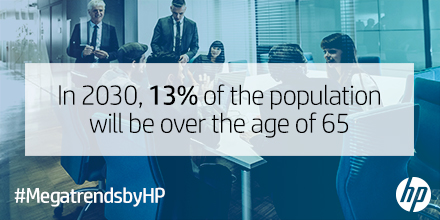
Yet at the same time more countries are becoming super-aged, which means more than 20 percent of their population is over the age of 65. By 2030, we’ll have twice as many people over age 65—nearly one billion.

In fact, per the World Bank Databank, by 2060 we’ll have 3B more people over the age of 30 than we do today. And as more countries are becoming super-aged with more than 20% of their population over the age of 65, we will experience a shrinking and aging workforce. China is a perfect example of this phenomenon. Today 26% of their population is over the age of 55. And according to UN Population data, that number will grow to 43% by 2030. To deal with this shift, China recently rescinded their one child policy after 35 years.

Picture1.png

To read the entire interview, head over to HP Labs’ blog and let me know your thoughts on Megatrends and their impact on our future in the comments section below.

Blog Futurism & Technology Trends Innovation

4 lessons in corporate reinvention from a tennis legend

I’m happy to have Prianka Srinivasan, Strategic Foresights Practitioner in the Technology Vision & Tech Ventures Team, as a guest blogger today. Before I hand the reins over, let me tell you a little bit about her.

PriankaHeadshotPrianka has spent 8 years at HP in various roles from competitive intelligence to business strategy and evangelizing the power of data analytics. Within the Office of the CTO, Prianka spends her time being a student of the future. She tracks social, economic, demographic and technology trends to identify and research future opportunities for HP. Her current obsession is the field of Artificial Intelligence. Outside of work, Prianka is a keen follower of world politics, a tennis fanatic and she tries to pursue one new hobby every year – 2016 is the year of Bikram Yoga for her.


Let me preface this blog by saying that I am an unabashed, die-hard fan of Roger Federer. So if this blog seems biased or overtly enthusiastic about the achievements of Mr. Federer – you know why!

Longevity is the common goal and aspiration of every human endeavor, whether in the arts, sciences, sports or business. But for businesses where disruption is the new norm it can be particularly challenging.  As so perfectly described in “No Ordinary Disruption, “ the ubiquity of the internet coupled with the power of digital platforms means that start-ups are instantly global entrants and micro-multinationals putting pressure on established businesses.

There are great examples of companies that have braved this vortex of disruption and come out on top – Netflix is one such maverick of reinvention. However sometimes when we look beyond our field we find some of the greatest insight off all. This post is an attempt at doing just that – examining the career of a legendary athlete and tennis player, to draw out lessons for how corporations might look at innovation and reinvention.

Tennis can be a brutal sport – an almost year-round season that spans the globe, varying surfaces and hard-hitting modern style of play that has become the benchmark thanks to advances in racquet and string technology. It is a sport that is unforgiving on the toll that time and aging take upon the athlete’s body. It has forced many a player into premature retirement – Bjorn Borg being the best example. Against this backdrop is one man, who has remained close to the apex of the tennis hierarchy for 17 years – a veritable aeon in the tennis world.

Much has been written about Roger Federer’s astronomical achievements, his gracious sportsmanship and balletic dance across tennis courts around the world. Spectating a Roger Federer match has even been likened to a religious experience by the illustrious David Foster Wallace! However, in my mind, what supersedes all of these facets in Roger’s game has been his ability to continually reinvent himself in the face of younger opponents and “father time”.

Turning failure into success

At the peak of his dominance Roger was virtually unbeatable. He set and broke many records, played shots that seemed to defy the laws of gravity and physics and he achieved it all with deceptive ease and nonchalance. But, as is natural, younger competition soon reared their head and sought to unseat the sovereignty of Roger. And in his typical gracious yet unrelenting style, Roger responded.

In 2008, after winning for 5 consecutive years on the hallowed lawns of the Wimbledon Championships, the prodigious Rafael Nadal defeated Roger Federer in what has been hailed as the best tennis match ever. Unfettered by his crushing defeat, Roger quickly regrouped, reimagined and defeated one foe after another on the road to capturing the US Open Grand Slam title.

So what is the lesson here? First, don’t let one defeat define the rest of your future. In the corporate and start-up world alike, one failure is seen as the end of the road – the media hype doesn’t help either. In times like these, it is important to remind yourself that you learn the most from your failures. Failure doesn’t define who you are; how quickly you get up, dust yourself off and get back in the game is what ultimately defines you.

Timing is everything

When your competitors are weak, strike hard, strike fast and go for the jugular. Remember that while you can never stay on top forever, neither can your competitors. It is important to be vigilant of what your competitors are doing and once you spot a chink in their armor, be ready to exploit the situation in your favor.

In 2010, things started to unravel in earnest for Roger. He managed to win the year-opening Grand Slam in Australia but fell to opponents he had once “owned” at the French Open, Wimbledon and the US Open. As far as the tennis media were concerned, this was indeed forewarning of Roger’s swansong. Instead Roger took stock of his team, his goals and took a decisive step. He hired a coach – Paul Annacone, the man who led Pete Sampras to his last Grand Slam.

Roger hadn’t had a full time coach for quite some time. To then pivot and hire a new voice showed Roger’s willingness to admit that he had run out of “tricks” and needed a new voice to reinvigorate his tennis.

Another important lesson in reinvention – be ready to recognize your shortcomings and do not hesitate in shaking things up to change your status quo. That which has made you successful in the past is not guaranteed to continue yielding positive results. It takes humility and a certain level of objectivity to acknowledge your failures and change old habits. In the corporate world, we often try to apply tried and tested mantras to produce results and we become so “married” to them that we are unable to pivot. Inertia of business models and processes often prevent us from “coloring outside the lines”. Seeking outside counsel, bringing in a new perspective is not enough – one must be ready to listen and change.

This is exactly what Roger did under the tutelage of Paul Annacone. Instead of sticking to the grueling baseline game that the younger generation had brought to tennis, Annacone urged Federer to come forward and be more aggressive. He urged Roger to shorten the points and impose his game with more conviction. Roger heard him loud and clear – and the results followed, most notably Nadal’s defeat at the year-ending ATP World Tour Finals where Roger eked out the win in three sets.

Step out of your comfort zone

As a 17-time grand slam champion and widely proclaimed as the best tennis player the game has ever seen, it would have been easy for Roger to stick to with what had brought him unprecedented success, even as the game changed around him.  It is testament to Roger’s modesty and objectivity that he was able to enact change in his game. Ultimately it is the lack of fear that allows Roger to take risks with his game in the pursuit of success.

Long-standing businesses that are faced with the changing basis of competition are often unwilling to take this gamble and eventually fall into obsolescence. Kodak is a great example of this. Kodak invented digital photography but the inertia of their photo fulfillment business prevented them from pivoting in a new direction. The old adage still stands – nothing ventured, nothing gained.

Be willing to experiment and change your approach

As the game changed so did Roger.  After struggling with injury and new competition he took a step back and took a long, hard look at his game and his tools. Federer had been using a smaller racquet throughout his career (90 sq. in), whilst most of his peers had a larger racquet area. In order to match the younger generation’s pace and power, Roger took the radical decision to try a racquet with a larger hitting area (98 sq. in).

Armed with a larger racquet and new techniques from a new coach, Roger reached the semifinals of the Australian Open in 2013. Although he lost to his nemesis Nadal, Roger was playing a refreshing brand of tennis that had been relegated to history by the increasingly baseline game of the new generation. His successes continued well into the next year.

Once again, 2013 and 2014 are testament to Roger’s ability to reinvent himself. He was able to part with his trusty racquet, bring in new coaching inspiration in the form of Stefan Edberg to put himself back in contention with the younger generation. He recognized what lacked in his arsenal to keep pace with the evolution of the game and did not hesitate to transform himself accordingly.

Businesses that face threats from nimble and fearless start-ups would do well to take a page out of Roger’s playbook and critically re-examine themselves. Understand where they are “behind the times” and enact whatever drastic change is required to become relevant again – even if this means cannibalizing your existing market share. Amazon is one of the best examples – a business built on selling physical books, recognized the on-coming wave of mobiles and tablets. To avoid becoming passé, they cannibalized their own business by pivoting to e-readers (Kindle) and a digital library of books.
Roger continues to change his game, adjust his strategies and seek the advice of others.  He’s never done, never satisfied, always in motion.

In the same vein, corporates today need to implement and measure the results of any and every strategy – no matter how distant from their core competencies. At a time when the minnows are firmly swimming with the sharks, it is time for the latter to build new muscles and employ new tricks. At the core of it all, is the pursuit of longevity without fear of failure or sentimental attachments to the past.

Like Roger has done numerous times, business leaders need to objectively take stock of their weaknesses and bravely look to upend deep rooted business models and processes. Ultimately in the game of corporate evolution, as in life, it is the fittest and most adaptable that survive.

Game on!

Blog Futurism & Technology Trends Guest Blog Posts Innovation

Megatrends: Rapid Urbanization

I recently sat down with HP Labs for Part 2 of a five-part series discussing HP’s future technology vision, and how key global forces known as Megatrends are being used to shape that vision and our future. Megatrends are global socio-economic, demographic and technological forces that will have a sustained and transformative impact on businesses, societies, economies, cultures and our personal lives in unimaginable ways in the years to come.

Blog Futurism & Technology Trends Innovation Videos

Megatrends: HP’s future technology vision

I recently sat down with HP Labs for Part 1 of a five-part series to discuss HP’s future technology vision, and how key global forces known as Megatrends are being used to shape that vision and our future.

Here’s a preview of our conversation.

Can you explain to us what you mean by Megatrends?

Megatrends are global socio-economic, demographic and technological forces that HP believes will have a sustained, transformative impact on the world in the years ahead – on businesses, societies, economies, cultures and our personal lives.

The world is in a constant state of change. In the next 15 years there will be more change than in all of human history to date.  And while we can never really know the future, understanding the Megatrends that are shaping the world around us can help point the way, and guide us on where the world is going, and the technology that will be needed into the future to help improve our lives.

At HP, we’ve identified four major Megatrends that we think are important: Rapid Urbanization, Changing Demographics, Hyper Globalization, and Accelerated Innovation.

Mass Urbanization | AndrewBolwell.com

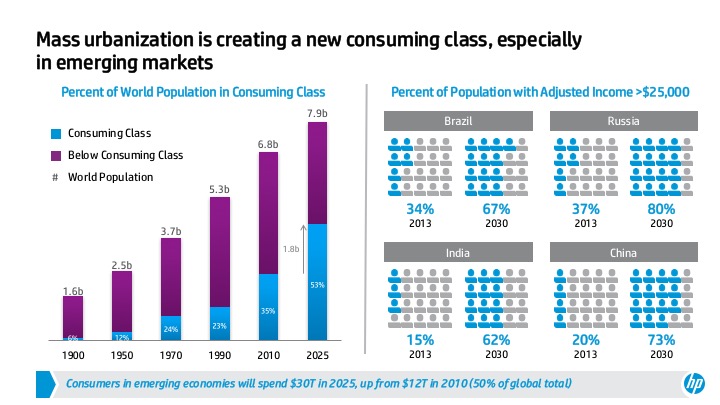
Let’s start with Rapid Urbanization: by 2030 there will be 8.5 billion people walking the earth. They will be drawn to cities in massive numbers for the promise of a better life.  Cities will become larger creating megacities. With bigger cities come major economic growth, particularly in emerging markets.  According to McKinsey by 2025, urbanization will welcome an additional 1.8B consumers to the world economy, 95% of them in emerging markets. It will also change how we buy and consume products and services, propelling the sharing economy and convenience-based services.  But such rapid urbanization will also take a toll on the environment, requiring us to find ways to reduce the strain on our natural resources and infrastructure.

To read the article in it’s entirety and the role I envision HP playing, please visit HP Labs’ blog.

Blog Futurism & Technology Trends Innovation

4 Influential Technologies to Watch in 2016

I often read articles detailing consumers’ struggle with change, but I disagree. I think consumers are exceptionally comfortable accepting new technology. Just five years ago it would have been hard to imagine that more than half of North Americans would share cars, housing, work spaces and more with a simple tap or click on their mobile phone or computer.

Blog Futurism & Technology Trends Innovation

Innovation: Staying in the Moment

In this TED talk, Joi Ito, head of the MIT Media Lab, shares how he used personal experiences to create one of the most successful citizen science projects in the world.

At HP, we’re constantly building and reinventing things. Staying in the moment or being a “now-ist”, as Ito calls it, is crucial when it comes to innovation. Here are my four tips for staying in the moment:

Blog Futurism & Technology Trends Innovation Videos